CKTax Voice & Tone
Building a content identity for a hybrid product caught between two brands
The challenge
Credit Karma Tax was a new, hybrid product: TurboTax-enabled tax filing inside the Credit Karma platform. I was part of a small team tasked with creating the content principles and design system for this new experience. But what would it actually sound like?
We needed to craft a verbal identity that would meet CK's audience where they where. They'd be less familiar with tax concepts than TurboTax folks, more price-anxious, and less likely to trust a non-tax platform with a high-stakes task.
My role
I worked with a lead content designer to co-author the voice, tone, and content principles from scratch, including a competitive audit, cross-functional workshops, and final documentation.
Our process
Understand the audience
Reviewed extensive research on the CK audience and sub-groups within it to clarify needs, wants, values and opportunities.
Narrow on framing
Analyzed voice across Intuit sub-brands (Credit Karma, TurboTax, QuickBooks, Mailchimp) to find opportunities for deviation and alignment.
Define voice and tone princples
Crafted our voice and mapped out tone considerations, dos and donts for different points in the filing process.
Understanding the CK audience
We were able to use existing research on the CK audience as a jumping-off point, including a financial wellness lifecycle model that ties content strategy to where someone is in their financial life:
With this framework, we started to ideate on how to build trust with and empower these subgroups, and what to avoid.
Common themes among the subgroups helped us understand what should be made a Bonafide Principle. Some things we felt strongly about:
- They value a personalized experience, no one-size-fits-all stuff.
- They want simplicity, but are not to be underestimated. [Meaning, no jargon, but don't dumb things down.]
- They need more clarity, and fewer surprises.
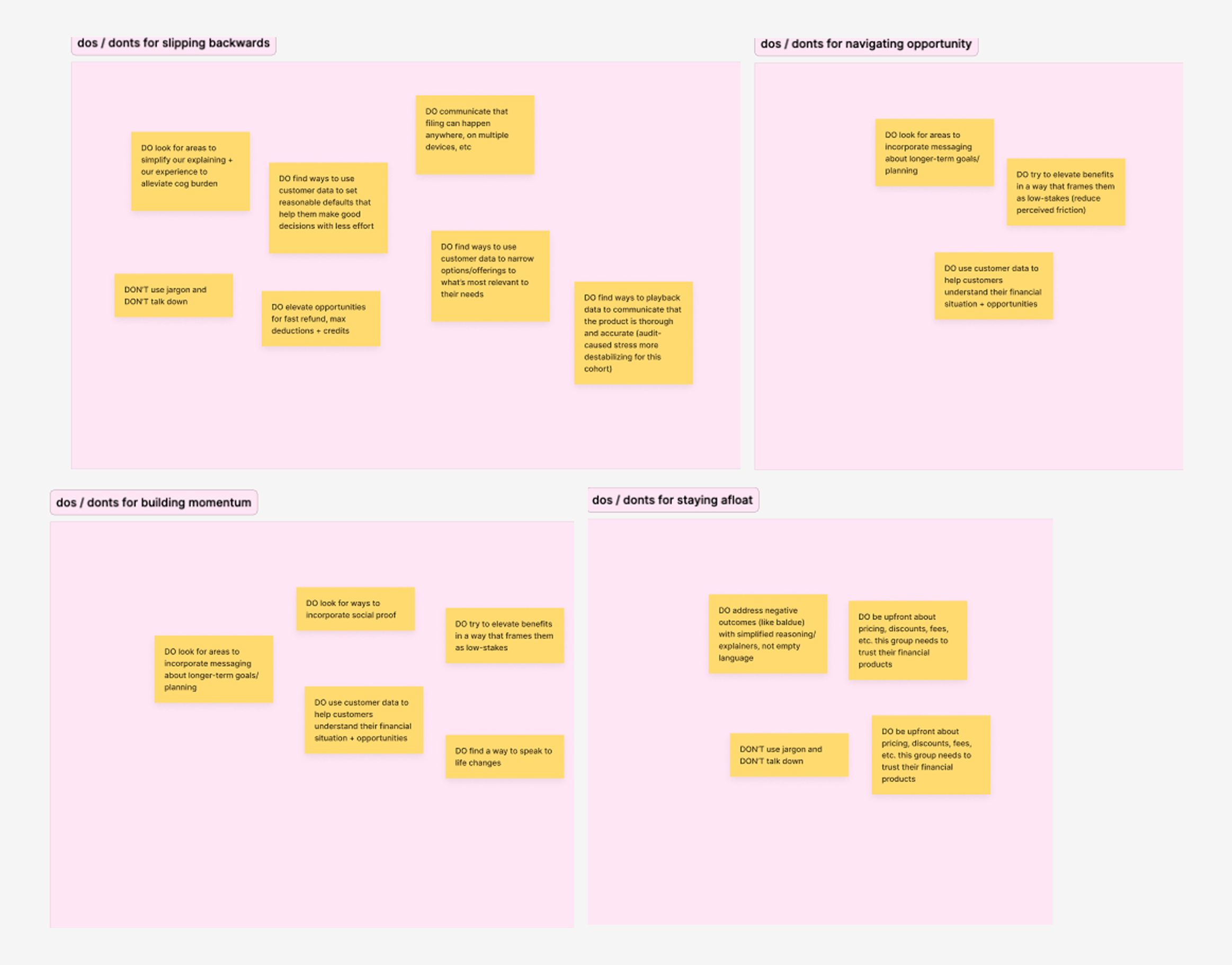
Dos/Donts for each lifecycle group
Narrowing in with a competitive audit
Once we had a good grasp of our audience, I designed and conducted a competitive audit across Intuit's sub-brands (Credit Karma, TurboTax, QuickBooks, and Mailchimp) and outside competitors like CashApp Tax to map out areas of divergence and alignment with CK's audience in mind.
Intuit brands shared a few instincts:
- Elevate the benefit
- Empower the customer
- Keep things simple
These were strong beats that we wanted to adopt. But some elements of the other brands wouldn't work for CKTax. TurboTax's empathetic commentary could sometimes feel patronizing and unearned, and CKTax needed a warmth that felt more subdued and practical to build trust.
We'd also want to avoid the sensationalized benefit language where possible. Marketing-ified claims about filing speed and cost often seen in TurboTax would amplify distrust for CK folks. We needed to lead with transparency.
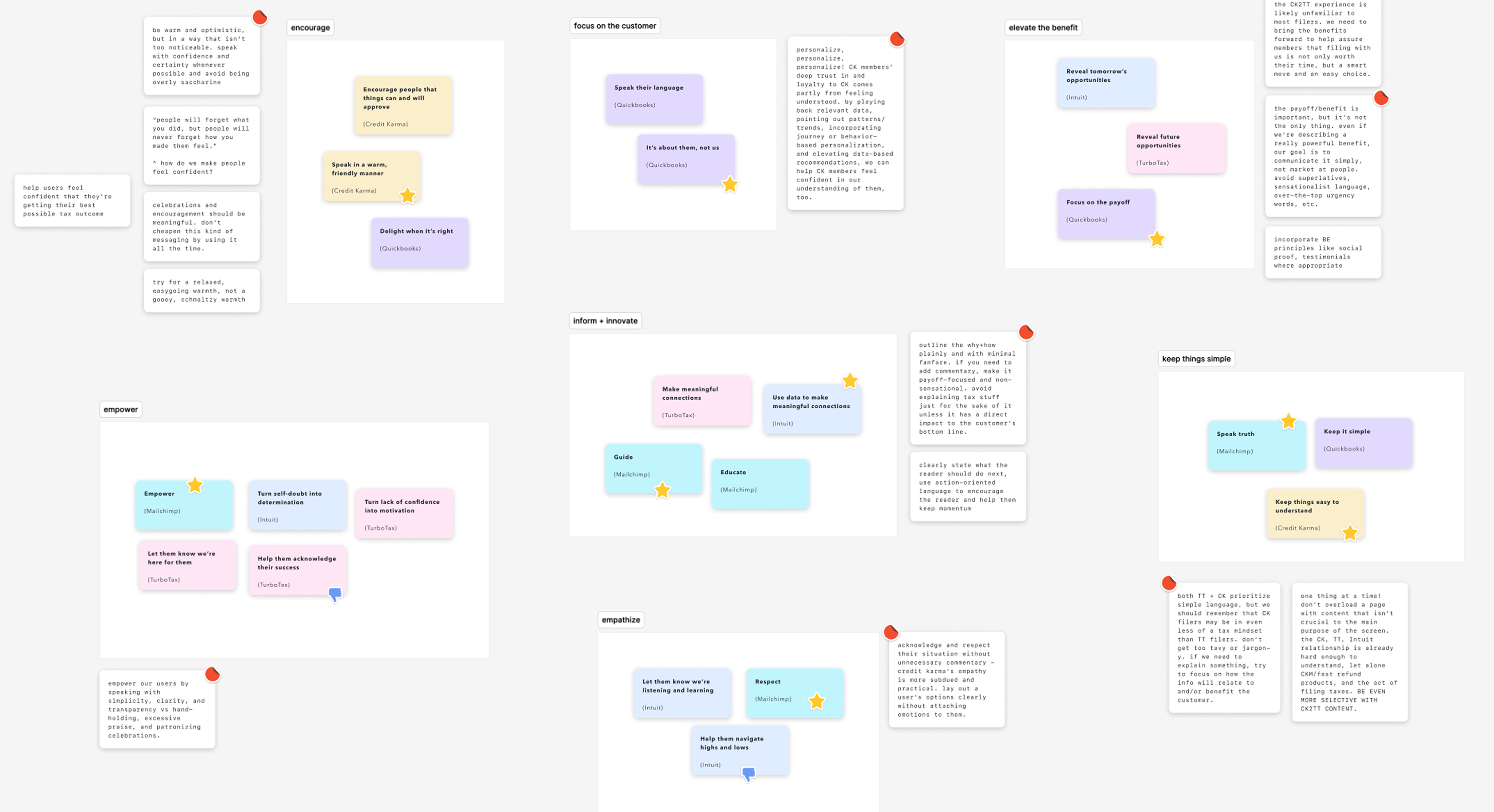
Competitive audit analyzing voice across Intuit sub-brands.
Defining the verbal identity
From audit insights, we could finalize our Dos, Dont's and Content Princples.
Over-celebration → Don't over-empathize.
Excessive encouragement and whimsy registered as patronizing for an audience that's anxious about accuracy. Our goal was to earn the celebration, not manufacture it.
Benefit credibility → Elevate the benefits, but don't oversell.
Several brands defaulted to superlatives and vague urgency ("instant refund," "file in 60 seconds"). CK's audience was already skeptical of financial promises that didn't deliver.
Jargon vs. clarity → Make taxes less intimidating.
Many tax products used terminology as a credibility signal. But CKTax's audience, potentially first-time digital filers, CPA switchers, responded better to what something meant for them personally.
Data transparency → Use data to make the experience personal.
CKTax was intended to be a highly personalized experience, using CK's member details to inform their tax filing. However, customers didn't fully understand the CK/TT relationship. Using their data without transparency could feel invasive, so we would ground personalization in playback and clarity.
These docs acted as more than a style guide, they told people who CKTax was and how we were positioning ourselves in the tax landscape. We were an antitode to overly technical products, we'd win on transparency where others obscure, and we're for people who don't identify as "tax people".
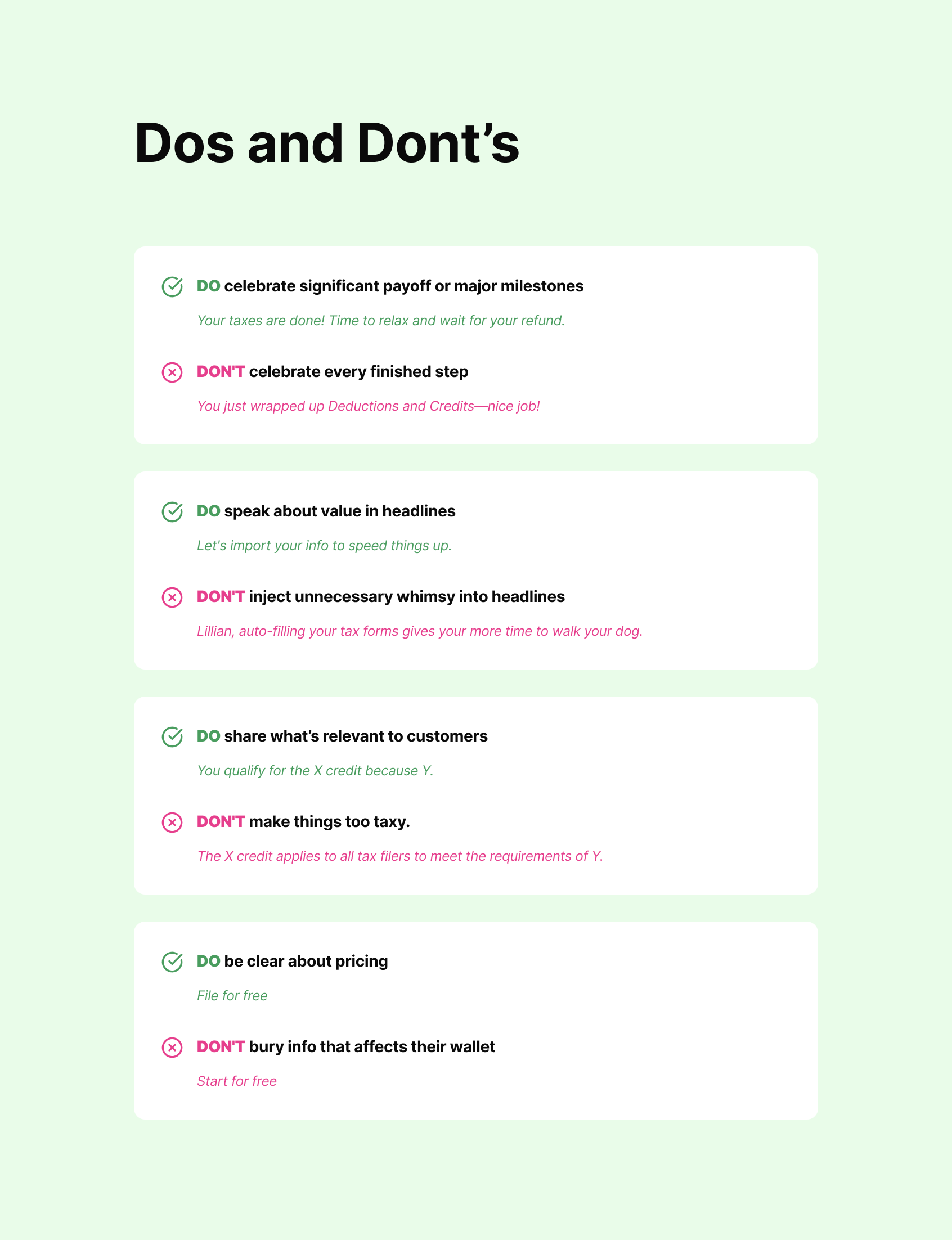
Do/don't guidelines grounded in real product copy.
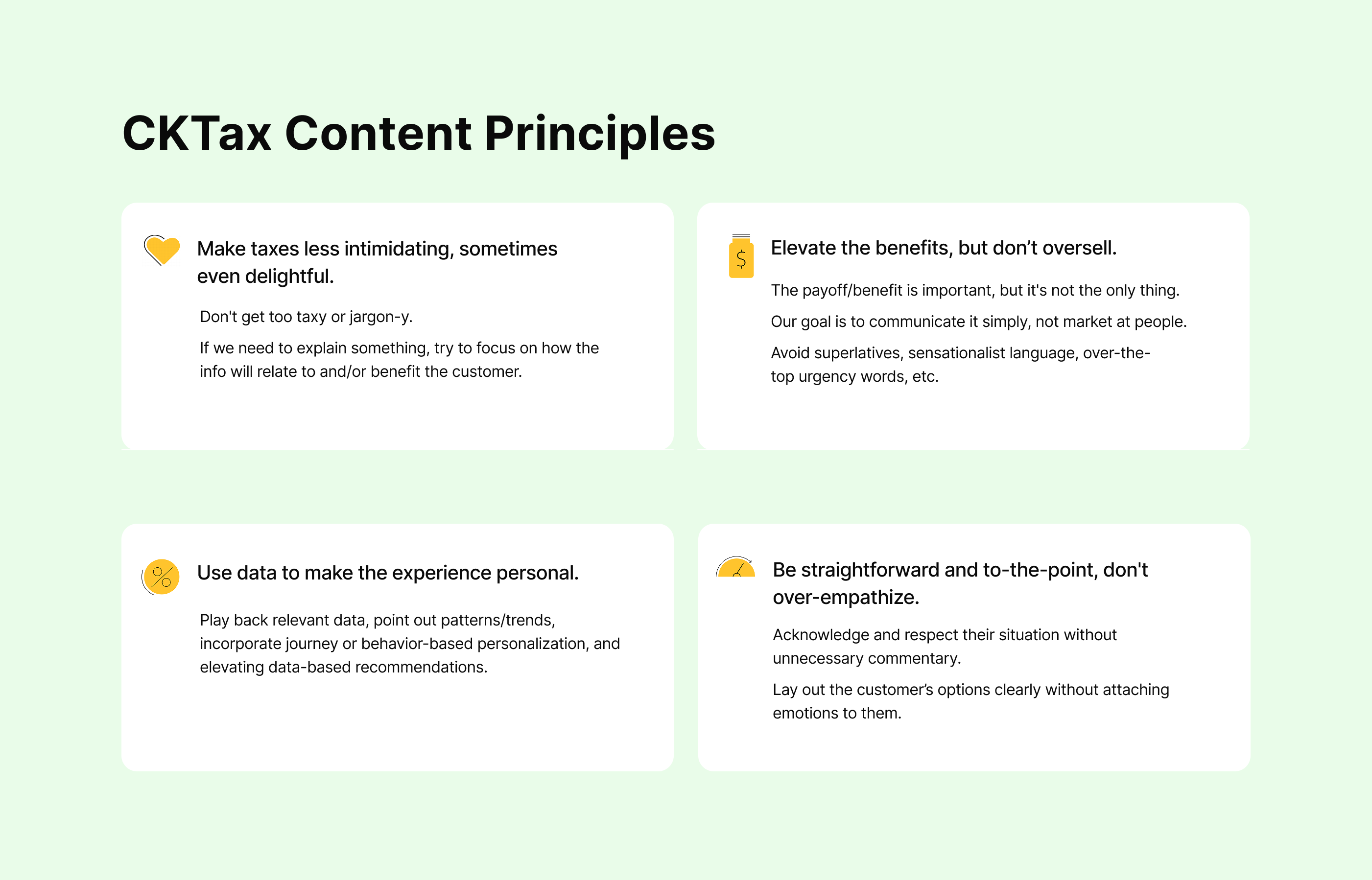
Content principles system overview for Credit Karma Tax.
Impact
CKTax was ultimately discontinued [sad trombone sound] due to business performance factors outside the scope of this work. The cost of running a separate tax product inside Credit Karma didn't justify the investment. However, the content system itself became the working standard for the team during its operation, and the psychological barriers framework was used to inform design decisions across the experience.