Proactive Intervention
Turning customer anxiety into opportunities for delightful expert assistance (and $5M in revenue)
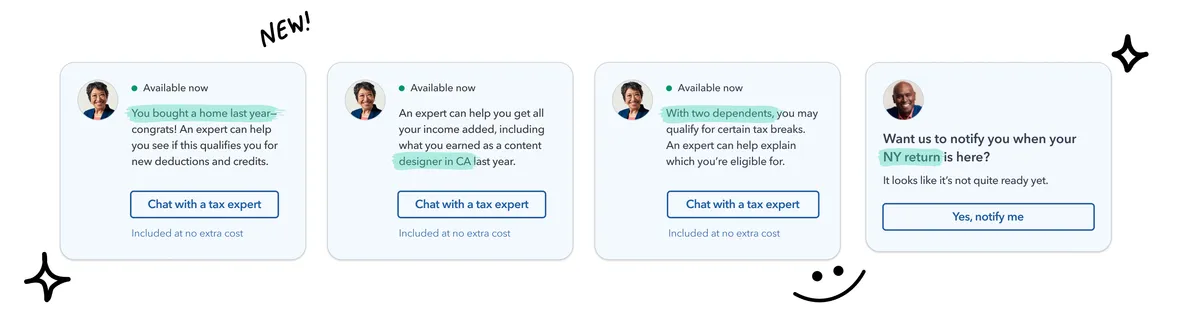
Examples of the finalized Proactive Intervention help offer cards
The challenge
The main value prop of TurboTax Live Assisted, unlimited expert help as you file, had a utilization problem. Customers chose to pay a premium specifically for expert support, but internal data showed only 21% of customers ever reached out. Many were struggling through complex tax topics and dropping off instead of connecting.
Qualitative research helped explain why. Many assumed expert access was an upsell rather than an included benefit. Others were confused about contact logistics. An existing "Live Help" button (persistent on every screen) was frequently mistaken for a chatbot.
Leadership hypothesized that proactive, AI-personalized help offers could bridge the gap. Our job was to figure out what that looked like.
My role
As the only content designer on this track, I worked closely with the AI team to define how to personalize content effectively and responsibly. This meant creating the content strategy, voice principles, and testing framework that could prove personalization's value.
What failed before and why
Proactive help had been tried before, but previous tests failed for a few reasons. Because the help offer appeared either as a top-right toast or a bottom-right fly-out card, they probably felt a bit like an interruption rather than timely, relevant help.
On the content side, the help offer felt generic and a little cold. The value of expert connection also wasn't clear enough. What would customers get from connecting with an expert that they couldn't just get from ChatGPT in a fraction of the time?
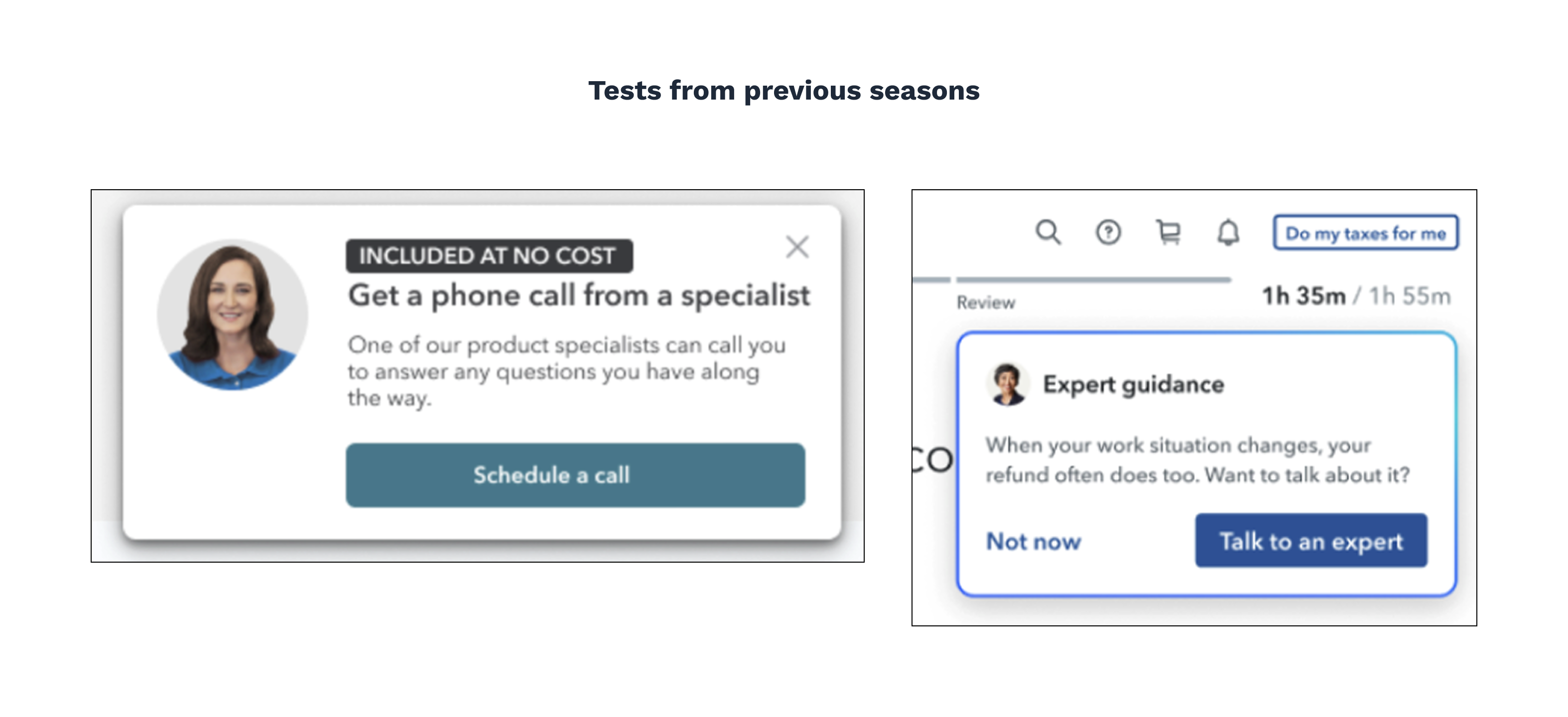
Previous tests: bottom-right flyout and top-right toast notifications.
Creating a content strategy
I focused on answering two questions: which customer data should inform the content, and how do we frame the help offer to make it feel worth the interruption? After an audit of previous work, here's where I landed:
1. Where appropriate, speak to customer's bottom line
I prioritized life event data (like retiring, buying house, etc.) and refund-impacting data (dependents, filing status) because they're memorable, emotionally resonant, and give customers a concrete reason to engage: money in their pocket.
"You bought a home last year—congrats! An expert can help you see if this qualifies you for certain tax deductions and credits."
2. Evoke attentive, hands-on care
Experts can offer guidance and reassurance, but we had to make that clear. Research showed customers worried about accuracy, so using specific phrases like "review it together," "go over what to expect" would paint a clear picture of support.
"An expert can help you get all your income added, including what you earned as a [occupation] in [state]."
3. Remove contact barriers proactively
Previous tests showed customers needed to know help was immediate and included. Prioritizing space on the cards for "Available now" and "Included at no extra cost" would reassure them that reaching out wouldn't cost time or money.
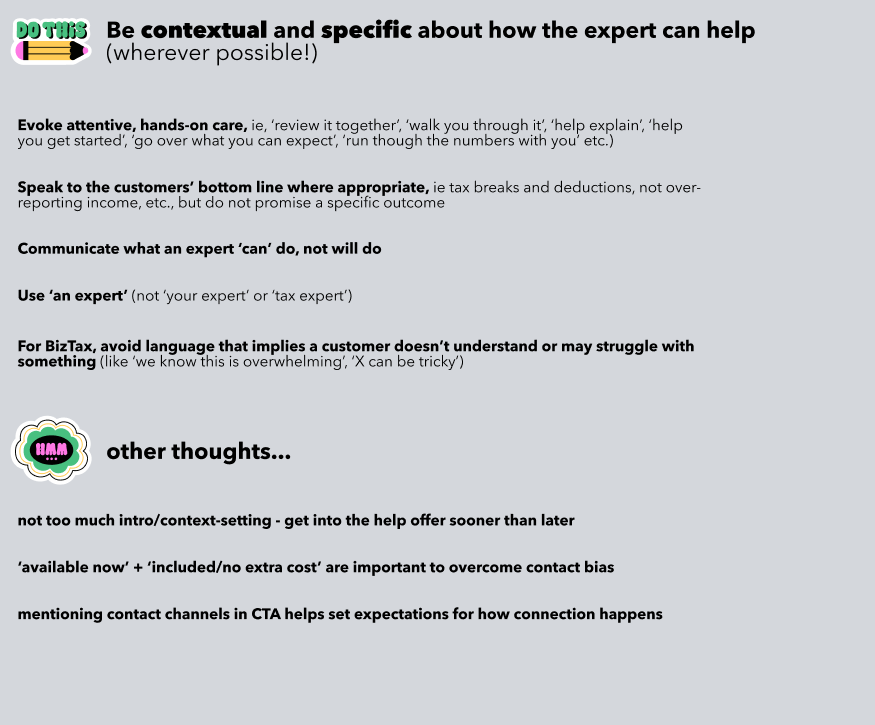
Content principles I developed for the help offer messaging.
From fully prompted content...
We initially intended the help offer content to be entirely AI-generated. My job was to make sure the generated content sounded like TurboTax and made sense for each screen.
The AI team set me up with a custom tool (Amazon SageMaker backend) to iterate on prompts and evaluate model outputs. I used a two level prompt system: The first level applied to all help offer content across the project. The second prompt was adjusted to fit the context of individual screens.
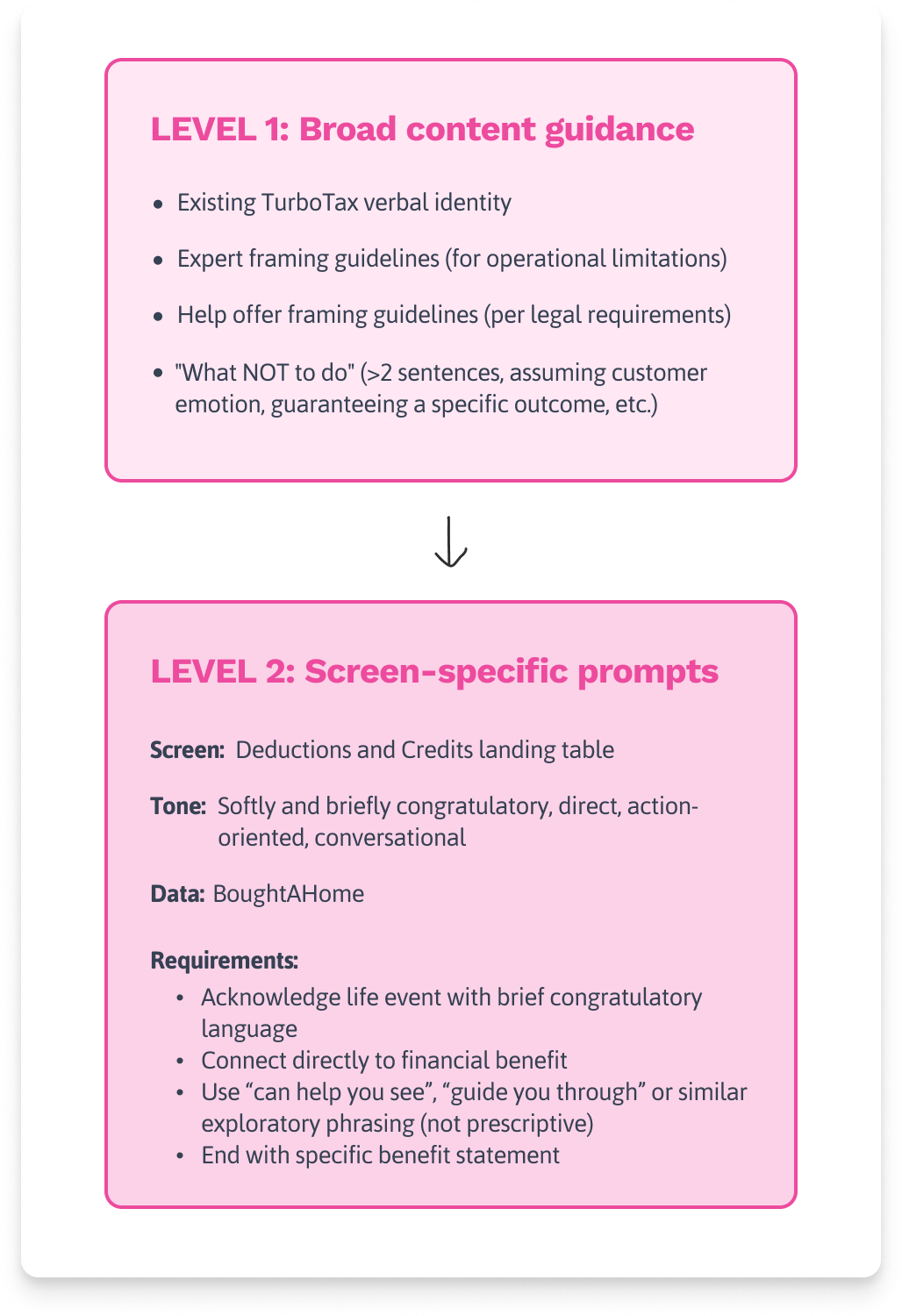
I used a dual prompt system to guide the outputs for each screen.
...To AI-enabled templates
Even after multiple prompt iterations, the LLM struggled to consistently match TurboTax's nuanced voice. Some outputs were too formal. Some were awkwardly phrased. Some were overly casual.
Further iteration would've kept us from hitting our deadlines, so I made the decision to lean into templates that could guarantee the TurboTax sound and voice:
- I wrote base content variations manually to ensure brand consistency.
- The AI team configured the model to follow my templates strictly.
- AI would handle variable insertion at scale and input customer data like occupation, state, life events, etc.
Today, this would be the perfect opportunity to systemize the help offer content. With a repository of exemplary offer messaging to feed our LLM, I think we could have come pretty close to hitting the right nuanced tone.
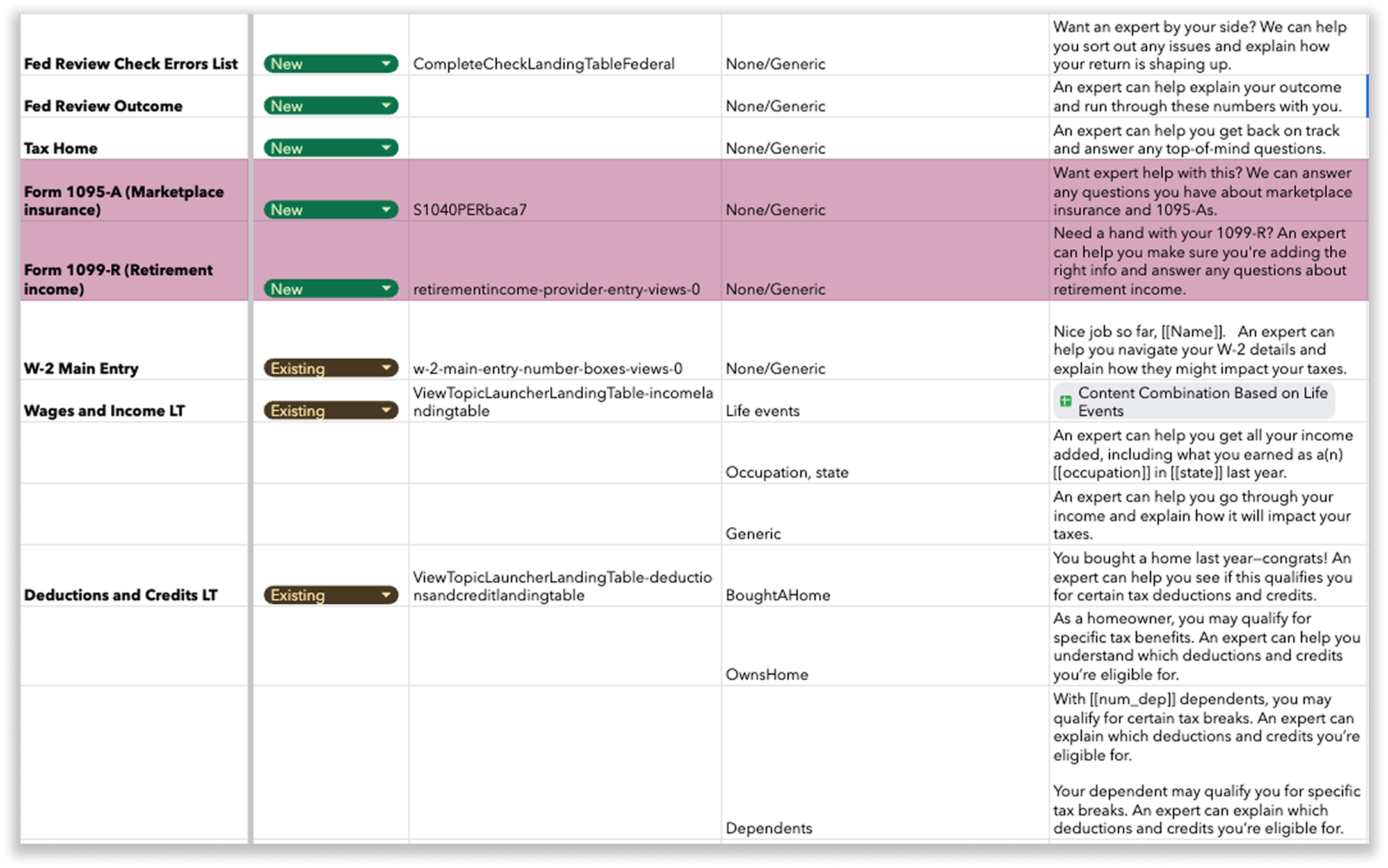
A sample of the templates I wrote, plus data variables that our model would insert.
Edge-case handling
Once we settled on template-tizing the content, I needed to determine how to handle cases where customer data was limited. I mapped out a tiered personalization hierarchy that ensured every customer would get a proactive, relevant help offer, even when we didn't have specific data for them.
"Your employment changed this year—we're here to help. An expert can walk you through any unemployment income and stock sales."
"An expert can help you get all your income added, including what you earned as a [teacher] in [California]."
"An expert can help you go through your income and explain how it'll impact your taxes this year."
Testing in product, learning fast
We launched a series of in-product tests to gather insights quickly, validate or disprove our hypotheses, and help shape the trajectory of the work.
We identified 6 unique, high-abandonment screens to test on, and I designed three content variants to help answer key strategic questions:
- What type of help do customers actually want? ("Self-serve" help content would test whether customers just wanted quick access to information vs. human connection)
- Does personalization meaningfully increase engagement? (And would the lift justify the engineering complexity and cost?)
- What kind of framing resonates most? (Speaking to bottom line? Contextual guidance? Hand-holding?)
Test results
Personalized content outperformed both static content and self-serve content (+3.5x CTR).
Refund, deduction, and credit-focused content was most successful, but we saw green shoots in content that offered guidance and hand-holding as well.
Moving forward, we rolled out the help widget to 6 more screens, optimized impression frequency and targeting, and abandoned self-serve content.
This work was moved to baseline early March 2025, becoming the default experience for TurboTax Live Assisted customers.
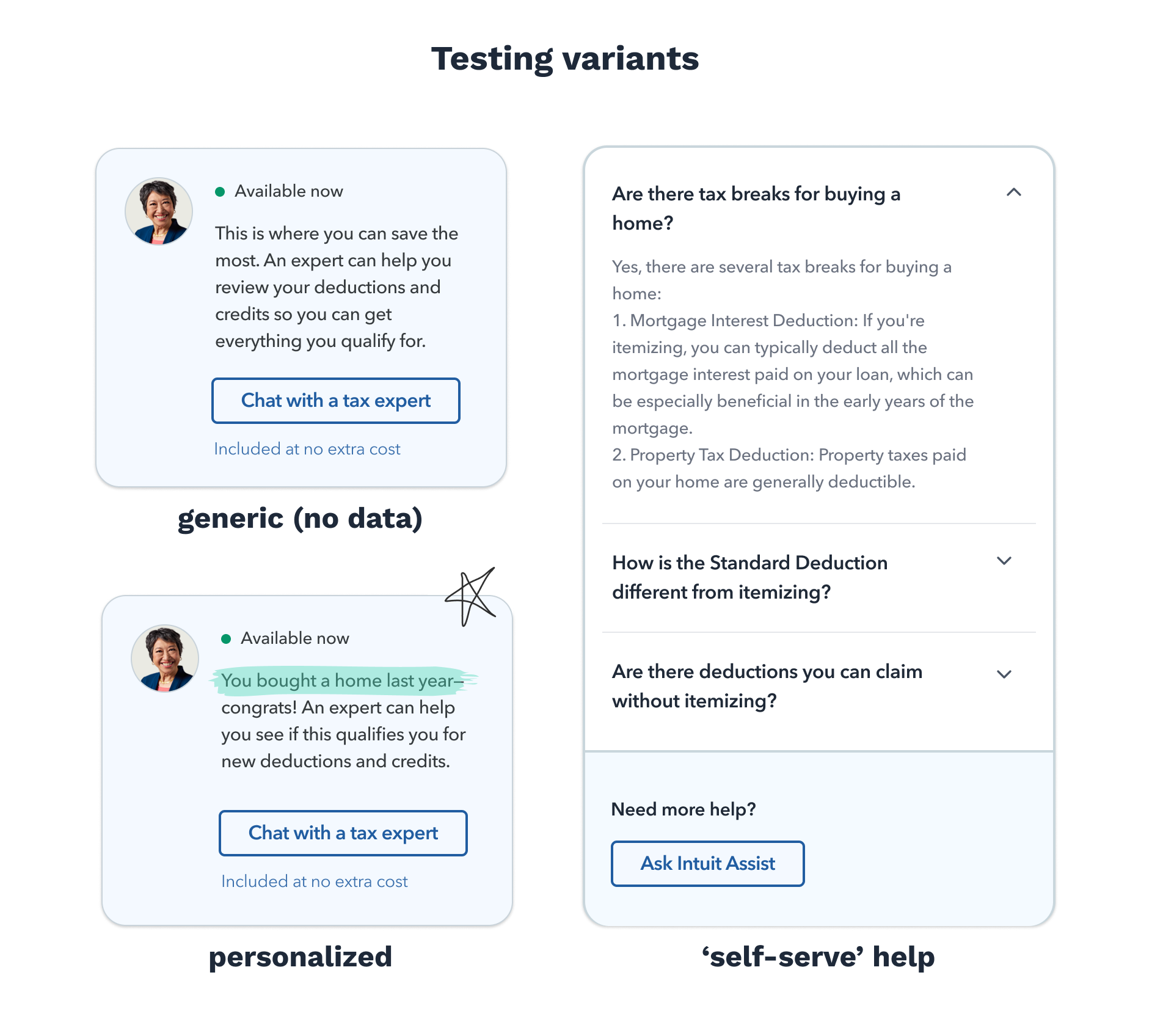
Testing variants: generic content, personalized content, and self-serve help.
End-of-season outcomes and impact
With our system of contextual, AI-personalized intervention cards, we achieved:
Business impact
- $5M in annualized revenue, becoming ROI-positive
- Increased revenue from new customers
Customer experience improvements
- 7% increase in customer resolution rate (89% vs. 73% overall)
- Contact rate increased to 103.7 ITC, indicating customers were more willing to reach out when help felt relevant
- Improved "Useful" click-through rate: 190 ITC
- 15% increase in tNPS (Transactional Net Promoter Score)
Reflections
Truthfully, our expert utilization problem would best be served by a multi-faceted solution: better top-of-funnel benefit education, improved feature discoverability, and a systems-level reimagining of the expert contact framework (that came later!). But we learned a lot about how to better connect customers to our powerful expert-help benefit. The ROI-positive $5M revenue win didn't hurt either. Our proactive intervention work was even rolled out to the Business Tax product, which I consulted on before leaving Intuit.